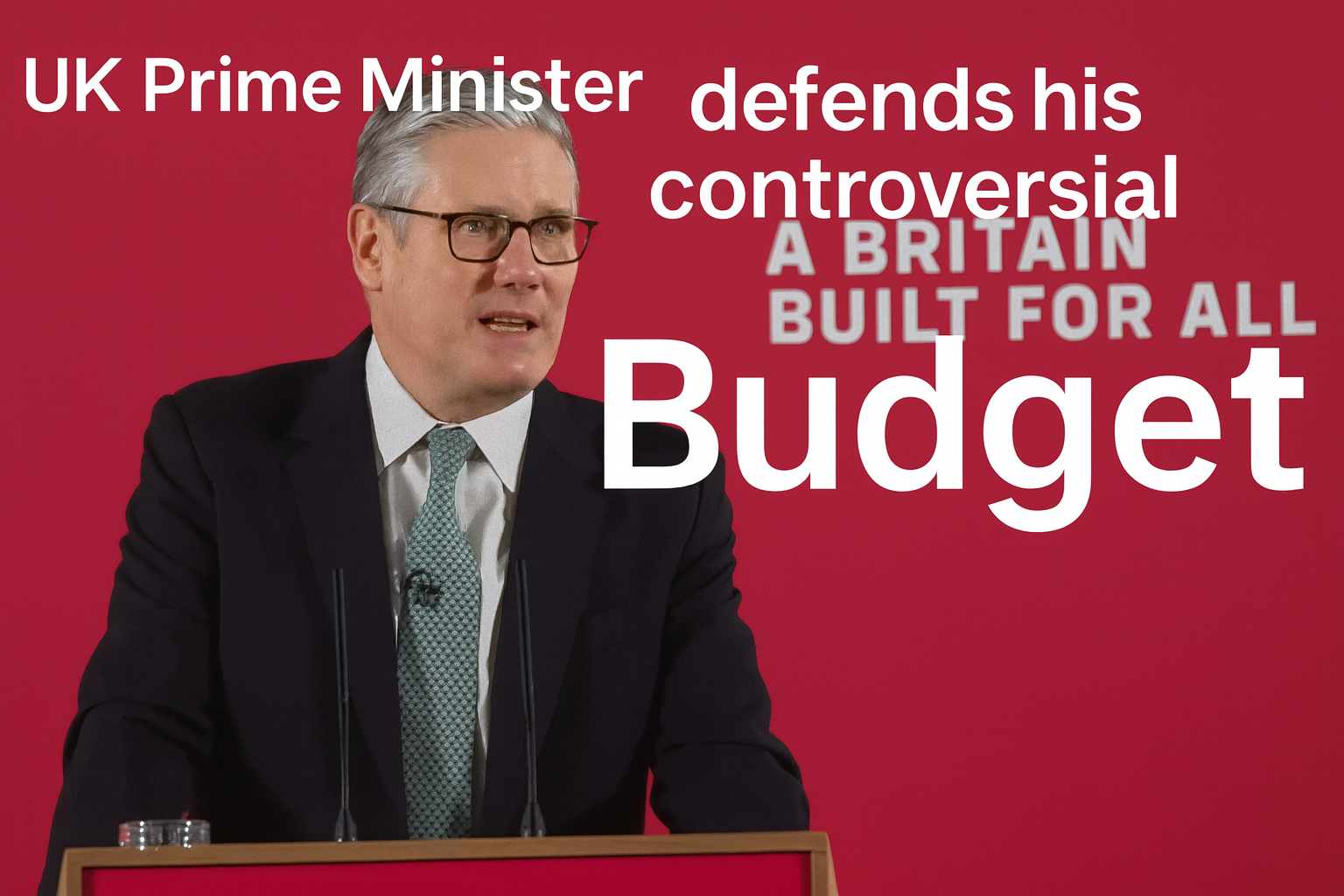
UK Prime Minister Keir Starmer's Foreign Policy Speech at the Lady Mayor's Banquet (December 2 2025)
Opening Remarks
Thank you, Miata. That was great. And I think your family are going to get a bit of a shock because they had no idea that you were doing that live on television this morning. They will be very proud to see you standing up here delivering those words. So really, really good. Miata, thank you very much.
Indeed.
And thank you to all of you for joining us at the Coin Street Neighbourhood Centre. You may have seen downstairs there’s a nursery. I’ve been down there with the young children this morning, seeing them and the staff, and seeing how the staff guide them from nine months to four years.
It is a real reminder that learning begins at such an early age and what a difference it makes. Giving our children the best start in life, unlocking their full potential, is so important to our country’s future. That is the purpose of this government in a nutshell.
I said it at Labour Party conference: we have a plan for Britain that is built for all, and we’re going to unlock the potential of every single person and community in this country.
Because whether it’s our public services that don’t work, the cost-of-living crisis holding people back, or whole regions of our country ignored as sources of growth – in the end, it’s all about potential.
On the Budget and Child Poverty
That’s why the Budget was a moment of personal pride for me. I do not want to see a country where children grow up in poverty. I don’t think anybody in this country wants that. It is a fundamental British belief that every child should go as far as their talent will take them. And poverty is a barrier to that.
Just think about it. Think about the skipped meals, the cold bedrooms, the school uniform that is too small or worn through. Think about a seven-year-old in that situation – a young girl or boy who still has to go to school and face the world’s gaze. Are they ready to learn to the best of their ability? Are we giving them a fair and equal opportunity to succeed? I think it’s abhorrent.
The Tories raised child poverty by 900,000 – 900,000 children. That is their worst legacy, bar none. It’s not just abhorrent, it’s also counterproductive.
On Wednesday last week, after the Budget, the Chancellor and I went to a hospital. We spoke to the staff who had gathered there and we told them that we’re lifting the two-child limit. They cheered. They said it matters because you wouldn’t believe how many children come through our doors because of poverty – poverty in Britain today.
So this is:
- a public-services issue – it can help lift the pressure on the NHS;
- an economic issue – a sound investment in our long-term potential;
- and a fairness issue.
This is what the Tories need to understand about the Britain they built: three-quarters of children growing up in poverty today come from working families.
Some of the parents I met downstairs, some of the parents I met in Rugby on the road last Thursday, told me – as so many parents do – that they’re working harder and harder but their wages struggle to meet their costs. I know what that feels like.
I remember my family sitting around the kitchen table worrying about the bills – how are we going to pay them all? We couldn’t pay them all. In our case our phone was cut off. That is still the reality of Britain for far too many people.
So yes, I am proud. I’m proud we scrapped the two-child limit. I’m proud we’re lifting over half a million children out of poverty. Proud we raised the national minimum wage again.
That is what a Labour government is for: making life better for working families, unlocking their potential, and giving our children a fair chance to get on.
Defending the Budget Choices
That is the story of the Budget. There were necessary choices. Of course there were fair choices. I would argue tax rises do make life harder for people – I understand that, it’s obvious. And I’m not going to pretend there aren’t alternatives. Politics is always about making choices.
We could have:
- cut public services;
- ignored child poverty;
- rolled the dice with extra borrowing.
But I firmly believe those options have been tested to destruction. We all know the risks of reckless borrowing – that is the path Liz Truss took, and you can see the cost in any bill, mortgage, car loan, anything affected by interest rates.
Look also at the OBR’s analysis of productivity. It is crystal clear to me that austerity scarred the long-term productive capability of this country. So why would we repeat it?
That is what we inherited: public finances and public services in total crisis, growth weak for years.
But if you’d said to me seventeen months ago, on the first day of government, that by now we would have:
- cut NHS waiting times;
- cut immigration;
- cut child poverty by a record amount;
- Britain cutting borrowing faster than any other G7 country without cutting public investment;
- our fiscal headroom up significantly;
- economic growth beating the forecasts with wages up more since the election than in a decade of the previous government;
- and because of all that, we can tackle the cost of living for working people – freezing rail fares, freezing prescription charges, freezing fuel duty, slashing childcare costs, driving down mortgages, taking £150 off your energy bills, £300 for poorer households –
then I would say yes, that is a record to be proud of. And I am proud.
I am proud the public finances and our public services are moving in the right direction because we confronted reality. We took control of our future and Britain is now back on track.
Looking Ahead
I am also confident we have now walked through the narrowest part of the tunnel. While I know it’s still hard for lots of people, while I know the cost-of-living crisis has not gone away, in the year ahead you will see the benefits of our approach – not just in the national statistics but in your communities.
You will see a country building its future with:
- new homes and infrastructure;
- 2,000 free breakfast clubs;
- hundreds of school-based nurseries open by September;
- 3,000 neighbourhood police officers on your streets by March;
- a new era of security for 11 million renters starting in May;
- hundreds of thousands of parents taking advantage of our free childcare expansion;
- almost 120 community diagnostic centres open seven days a week by April.
You will see NHS waiting times coming down further, wages still rising faster than prices, immigration still falling, and bit by bit you will see a country that no longer feels the burden of decline or the sense that things can never get better – a Britain with its confidence and its future back.
Take our energy policy. That’s £150 off your energy bill, £300 if you’re really struggling. Think what that means to a family worried about whether to put the heating on on a cold day, or worried that if they switch it on for too long they might have to cancel a day out with their kids. It’s not just money. It’s security. It’s having the freedom to make choices that help your family.
Or think about our childcare investment: 30 hours free for every child between nine months and four years old. A massive difference to the cost of living – thousands of pounds back in the pockets of working parents. Real help getting parents and carers back to work, especially women. Good for growth, but also good for our children’s potential.
I visit primary schools all the time. Teachers repeatedly tell me, right across the country, that some kids arrive at reception reading books, ready to learn, while others are still in nappies. I am sick of hearing those stories. Inequality at age four, baked in for life and likely to last a whole lifetime.
That’s why everything we’re doing for children is a game-changer for our potential. We’re giving every child the best start in life, every single child equal at the starting line of their education. That is what a Labour government is for.
[Applause]
Economic Growth and Next Steps
When it comes to economic growth and living standards, we’re confident we can beat the forecasts. We’ve already beaten them this year. We are in control of our future. We’ve already struck trade deals attracting billions of pounds of investment. We’re removing barriers to business right across the economy – in planning, industrial policy, pension reform, artificial intelligence, capital investment.
Right at the heart of the Budget we have a package of measures that give the green light for the world’s best entrepreneurs to start, scale, and list their companies in Britain.
But we have to be clear: at this stage of our plan the most important things we can do for growth and for business are:
- first, to drive inflation down so interest rates come down further still and the cost of business investment comes down with it;
- and second, to retain market confidence that allows for real economic stability so businesses can plan with certainty.
That is what the country needs most right now. It is what the Budget secured, and that’s why our choices were fair, necessary, and fundamentally good for growth.
But I will level with you: as the Budget showed, the path to a Britain that is truly built for all requires many more decisions that are not cost-free and are not easy.
We can all see the challenge: low productivity, the result of an economy scarred by austerity, by Brexit, and by consistently failing to unlock the nation’s potential. So we need a productivity revolution.
As our plan runs to the end of this Parliament, I want to set out some of the next steps in our economic renewal so that our progress can be fairly judged.
Next Steps
Regulation
- Exactly a week ago John Fingleton reported on our nuclear industry. He found that pointless gold-plating, unnecessary red tape, well-intentioned but fundamentally misguided environmental regulations – and I quote – “a mindset that favours process over outcome has all made Britain the most expensive place to build nuclear power.”
- I agree with him. In fact I would go further, because we see that story repeated again and again right across our economy. For years Britain did not have a proper industrial strategy. For years it cut public investment. For years it did not have a planning framework or a government that would quickly approve new railways, new tram lines, data centres, laboratories, power stations, wind farms – even whole towns.
- Guided by a simple truth that rooting out excessive costs in every corner of our economy is an essential step to cutting the cost of living and creating more dynamic markets for business, we will clear the path for British business. Therefore, in addition to accepting the Fingleton recommendations, I’m asking the Business Secretary to apply these lessons across the entire industrial strategy.
Welfare
- For too long our welfare system has trapped people in poverty – and poverty is always a barrier to potential. That’s why we scrapped the two-child limit. But we also have to confront the reality that our welfare state is trapping people not just in poverty but out of work – young people in particular. That is a poverty of ambition.
- While we will invest in apprenticeships and make sure young people without a job have a guaranteed offer of training or work, we must also reform the welfare state itself. That is what renewal demands.
- This is not about propping up a broken status quo, nor because we want to look politically tough. The Tories played that game – the welfare bill went up by £88 billion and they left children too poor to eat and wrote young people off as too ill to work. That was a total failure.
- We’ve asked Alan Milburn to report on the whole issue of young people’s inactivity and work because we need to remove all the barriers that hold back the potential of our young people – whether that’s mental-health issues, or you’re simply written off because you’re neurodivergent or disabled. Then it can trap you in a cycle of worklessness and dependency for decades. That costs the country money, is bad for our productivity, and most importantly of all is a massive waste of potential. Any Labour Party worth the name cannot ignore that.
Trade
- Vital for productivity, essential for growth, crucial to the cost of living.
- Let me be crystal clear: there is no credible economic vision for Britain that does not position us as an open trading economy.
- We must all now confront the reality that the Brexit deal we have significantly hurt our economy. For economic renewal we have to keep reducing frictions. We have to keep moving towards a closer relationship with the EU and we have to be grown-up about that – to accept that this will require trade-offs. That applies to our trading relations right across the world.
- As you’ve seen already with this government, there are deals to be done if you’re committed to building relationships. That’s what we’ve done with the US, with India, and with the EU. We will keep going. We will continue to reject drift, to confront reality, and to take control of our future.
That is what the Budget achieved last week, and we will build on it: a long-term plan for the economic renewal of this country. A Britain that is free from decline, confident about its future, and with the potential of every single person unlocked – truly built for all.
Thank you very much.
[Applause]
Q&A Session
Thank you. I’m now going to take a number of questions from the media.
Chris Mason, BBC
Thank you, Prime Minister. As a former lawyer you’ll be familiar with the concept of people offering the truth, the whole truth, and nothing but the truth. Isn’t the reality that in failing to be candid about the breadth of what she knew at her pre-Budget news conference, the Chancellor misled us? And if I may, on reform of the welfare system, how fundamental is it to you that the benefits bill starts to fall?
Response
Well look, on the build-up to the Budget, let me step through that in some detail. There was no OBR productivity review under the previous government. The result of that was £16 billion less than we might otherwise have had. That’s a difficult starting point for any Budget.
We had already made commitments – which I expressed many times – that we were going to protect our public services, particularly the NHS, cut borrowing costs, and bear down on the cost of living.
So on the one hand £16 billion less than we might have had; on the other hand clear commitments we had made throughout the process as to what we were going to achieve. Against that backdrop it was inevitable that we would always have to raise revenue. So there was no misleading there.
During the overall process the numbers improved, and there was a point at which we thought – myself included – that we might have to reach for a manifesto breach of some significance. I didn’t want to get to that place but I recognised we might have to. As the process continued it became clear that we might be able to do what we needed to do with our priorities without that manifesto breach, and that’s what we did with the fair and necessary decisions we took.
On welfare: there are a number of aspects to this. The welfare bill went up extraordinarily under the last government. But there is also what I would call a moral mission. I have been particularly concerned about the best part of a million young people who are not in work and not learning.
Over and above any other issue I think it’s a moral issue, because all the evidence points to this: if you’re not earning or learning at that age the likelihood is it’s going to be much more difficult to get into earning and learning later in your life.
Thank you very much, Chris.
Beth Rigby, Sky News
Prime Minister, we found out from the Office for Budget Responsibility that the Chancellor, with your backing, misled the public on November 4th when she warned about a black hole in the public finances without telling us the second bit – that higher-than-expected tax receipts meant the economy was in a much healthier position than the Chancellor publicly suggested. A cabinet minister has told me this morning they do feel misled. How do you respond, and can you really commit to driving through welfare cuts given that some at your top table don’t have confidence in you?
Response
There was no misleading, and I simply don’t accept – and I was receiving the numbers – that being told the OBR productivity review means you’ve got £16 billion less than you would otherwise have had shows an easy starting point. Yes, of course all the other figures have to be taken into account, but we started the process with significantly less than we would otherwise have had.
This is not an annual exercise; it’s an exercise that was done this year. I’m not sure why it wasn’t done at the end of the last government, because that would have seemed a sensible time. But it was done, and the net result was £16 billion less than you would otherwise have got.
That meant, measured against our objectives – protecting public services, doing what we could on headroom (which I really wanted to more than double), and bearing down on the cost of living because I know that for families and communities that is the single most important issue – we wanted to achieve all those things starting that exercise with £16 billion less than we might otherwise have had.
There was a point at which we did think we would have to breach the manifesto. Later on it became possible to do it without the manifesto breach. Given the choice between the two, I didn’t want to reach the manifesto breach, and that’s why we came to the decisions we did.
On welfare, this is a moral mission. I don’t think we can simply leave the best part of a million young people not earning or learning and walk past it. Just as I fundamentally believe we’ve got to lift children out of poverty – that is a moral and personal mission for me – so too I feel very strongly about the million young people who, unless we intervene, could well spend the rest of their lives in that kind of dependency. I think that’s wrong in principle.
Thank you, Beth.
Robert Peston, ITV
For my sins I’ve reported on Budgets for 35 years, and truthfully I have never seen preparations for a Budget as shambolic as these, except for Liz Truss’s mini-Budget – and we all know how that ended. Is this the Chancellor’s fault or is it your fault? And just briefly, you mentioned you want to drive faster on trade. Your current proposals for the EU are not economically significant. Are you going to drive harder and faster in getting a better trade deal with the EU?
Response
Robert, let me deal with the substance of the Budget because it’s really important we focus on that. In my view we have protected our public services and our NHS – that is hugely important. The NHS was on its knees after 14 years of the last government. Now we’re bringing waiting times down. That is not easy; it requires record investment and fair and necessary decisions. I’m proud of that.
We have more than doubled the headroom, and every business knows that helps with stability and certainty, which is what they’re looking for above all else. And we’ve borne down on the cost of living. I’m proud that we’ve lifted half a million children out of poverty.
The idea that for the best part of ten years the two-child cap would have any effect other than dragging hundreds of thousands of children into poverty has been tried and tested to destruction. We’re ending that, and I’m proud of that.
I’m also proud that we took the decision not just to freeze rail fares and prescriptions but to take down energy bills by £150. In the hospital we went to on the afternoon of the Budget, when we told them that, they broke out in applause because they knew what it would mean to them.
On the substance of the Budget I defend it any day of the week. They are the right steps for our country.
On trade: we do need to get closer to the EU. It is clear from all the analysis that the deal we’ve got has hurt our economy. That’s why we’ve rebuilt and reset relations with the EU, why we had the mandates agreed for the SPS agreement that will drive down costs in supermarkets significantly, particularly food costs, and the emissions trading scheme link just in the last week or two. We’re making progress, in addition to the other trade deals we’ve done with the US and with India. I’m proud that we’re making that progress.
Thank you very much.
Chris Hope, GB News
You wanted to tread lightly on our lives before you were elected – you were different from the Tory party – but aren’t you exactly the same? From David Lammy repeatedly not being clear about an escaped migrant in the Commons to Rachel Reeves talking about a black hole that wasn’t actually there, now you want to cut benefits. Trust matters. How can our viewers trust anything you say?
Response
Chris, I simply don’t accept the starting proposition. When I was told we started the Budget process £16 billion down, I didn’t cheer. I thought it was a very bad starting position. I was curious as to why the productivity review had been done this year and not previously, but there we are. I’m handed the tab: £16 billion less.
I won’t accept the proposition that somehow this was a good starting point. I’m £16 billion down on what I thought I’d have, and I know the impact that’s going to have on your viewers because for them the cost of living is the single most important issue. They’re going to be worried in January whether their season ticket is going up, prescription charges matter to them, and energy bills matter to them.
If that £16 billion productivity hit hadn’t happened I’d have had £16 billion more to weigh in the options and choices we made. Two-thirds of the headroom is £16 billion – you can see the significance of that amount of money.
All I can do is explain the impact these decisions have on your viewers and assure them that I am well aware that the number-one issue for them is the cost of living. That’s why in the Budget and all the other decisions – free school meals, free breakfast clubs, free childcare – all of these are good for children in their own right but also really important cost-of-living measures.
Thank you very much.
Aubrey Allegretti, The Times
Given we now know you had a Budget surplus of at least £4 billion before Rachel Reeves gave her press conference, isn’t it misleading of her to have still not ruled out an income-tax rise and only given us one side of the story after she’d been made aware things were better than anticipated? Do you think the OBR has overstepped its remit by publishing what forecasts it gave to the Treasury, and when do you actually think having more transparency like that is a good thing?
Response
Aubrey, I’ve been through this a number of times, but at the early stage it’s very important not to rule out steps because it’s a process that goes on for some weeks until final decisions are made.
To be told at the beginning of the process that you’re £16 billion worse off than you might otherwise have been is a significantly difficult starting point.
We could have made other choices. I could have said we’re not going to protect the NHS any more, or we’re not going to more than double the headroom, or we’re not going to bother about any cost-of-living measures. I fundamentally disagreed with that.
It was right that we flagged we started in this position, and my strong view is it would have been wrong to rule out measures that would have to be taken as a result – and in fact were taken, because there were tax rises in the Budget.
In relation to publishing the figures, that’s a matter for Richard Hughes to explain rather than me.
Jess Elgot, The Guardian
You’ve said a few times that you will beat the OBR’s gloomy forecasts on growth or living standards. You’re clearly very angry at the timing of the productivity downgrade, and you’ve given them figures that you know you’ll probably never have to act on – spending cuts before the next election. What is the point of the OBR if it clearly doesn’t command your confidence?
Response
I’m not angry at the productivity review. It’s a good thing that reviews like that are done from time to time. I just feel that doing it at the end of the last government and before we started might have been a good point so we could know exactly what we were confronted with.
On beating the forecast: I am confident, and I’m confident because the forecast given to us for 2025 for economic growth was 1% and it came in last week at 1.5%. That’s a 50% overreach on the forecast. I know these targets can be beaten and we are absolutely out to defy the forecasts and beat them, just as we’ve already done this year.
On the OBR, I’m very supportive of the OBR. It is vital for stability and inbuilt in our fiscal rules, which I’ve said a number of times are ironclad.
I’m not going to suggest that what happened last week – the entire Budget being published before the Chancellor got to her feet – was anything other than a serious error. It was market-sensitive information and a massive discourtesy to Parliament. There’s an investigation going on. But as for the OBR itself I’m very supportive for the reasons I’ve set out.
Lizzie Buchan, Daily Mirror
You talked about looking again at welfare reform but you failed to pass your measures the last time you tried. Can you take your MPs with you this time, and would you take the whip off people if they oppose cuts to welfare?
Response
On this issue I’m focusing particularly on young people. There is a general consensus that this is a moral mission. There aren’t many people who are comfortable – nor should they be – with the fact there are nearly a million young people stuck not earning and not learning.
My big worry is that all the evidence I’ve seen shows that if at that age that’s the situation, the likelihood is it’s going to go on for decades and impact that cohort.
There is strong consensus that we must do something about that. We will do something about it.
Chuck Elson, The Sun
Is it your goal that welfare spending by the next election will be coming down and not up? And your Chancellor said she was asking ordinary workers to contribute a little bit more – what about your measures for people who aren’t contributing at all?
Response
We’ve got two reviews going on – the Sims review and the Milburn review – and we need to let them complete their course. It is a moral mission, but I’ve been outspoken that the last government lost control of welfare spending, and like all things it falls to us to pick up the mess they made.
We are asking everybody to contribute a little bit more. It’s really important to appreciate that with the two-child limit, three-quarters of children in poverty are in working families. It’s the working poor we’re dealing with here – families who are working but can’t make enough from their wages to keep their children out of poverty. I think we should do something about that.
It’s the right thing to do for children, for the NHS, and for the economy.
Chris Chandler, news with Chris
The government is lifting the two-child benefit cap from next April, but with working families being told they need to contribute more and the two-child benefit cap not being lifted from next April, what reassurance can you give families right now that are struggling this winter?
Response
For families struggling this winter I want to give the reassurance that we’re taking a number of measures on the cost of living, because for them that’s probably the thing uppermost in their mind: can I make ends meet, can I pay the bills?
That happened to me when I was growing up. We didn’t have enough money to pay all our bills; we had to sit around the kitchen table and decide which bills we wouldn’t pay. That’s why our phone was cut off.
Those are the decisions families are going through this winter. That’s why we are taking measures on rail fares, prescriptions, energy bills down by £150 – and for those struggling most that’s on top of the £150 we’re already taking off. Last winter three million families that needed it most had their energy bills reduced by £150; we’ve extended that to six million of the poorest families this winter.
For anyone who can benefit from free breakfast clubs, free school meals, free childcare from nine months – it saves a significant amount of money and helps parents and carers get back into work if they want to.
It’s hugely important for children because children aged four ought to be at the same point on the starting line. I’m sick of hearing that at age four some are ready to learn and some are still in nappies.
Andrew, news ASB
What guarantees can you give that your government will be transparent about fiscal realities even if the news is politically inconvenient?
Response
I think by standing up here and walking through the decisions we’ve made, hopefully that helps explain the process and very much sets out the substance and content of the Budget and the driving principles behind it: that we wanted to protect public services, our NHS in particular – most people would say that’s a good thing because they need to know the NHS is there for them and their families when they need it.
One of the saddest things under the last government is that when Labour left power we had the lowest waiting lists and the highest confidence in the NHS. At the last election we had the highest waiting lists and the lowest confidence.
We were determined to turn that around, to bring down the cost of borrowing because that impacts on interest rates, and to be transparently clear that the cost of living is the single most important thing for most families and communities across the country.
They will want to know – and through you questioning me can know – that we’ve taken a number of measures on the cost of living which will help. It doesn’t eradicate the problem but it helps, and also gives the sense that we’re a government that does actually understand what a cost-of-living crisis feels like and is determined to make the fair and necessary decisions to deal with it.
Thank you all very much indeed. Thank you.
More Posts
No more posts.