President William Ruto’s Jamhuri Day Speech Delivered on December 12, 2025, at Nyayo National Stadium
Your Excellencies, distinguished friends, fellow citizens,
Opening Reflections
I have always observed this day with two emotions held in tension:
- deep gratitude to our forefathers
- a restless question for ourselves.
Have we been faithful stewards of the freedom they won? And have we truly advanced the nation they left in our hands?
I shall return to these questions later. But first, today we gather not just to mark a date on the calendar, but to honour a legacy written in sacrifice, courage, and unbreakable resolve. A legacy forged by men and women who stared imperial power in the face and declared with unshakable conviction that Kenya would be free. Their struggle planted our republic on the firm foundation of liberty, unity, and democracy. They gave us more than a flag. They gave us a future.
The Struggle for Political Independence
Sixty-two years ago, the brave architects of our nation placed in our hands the priceless gift of political independence. On this very day, 62 years ago, our forefathers lowered the Union Jack and raised the flag of our nation. But that victory was not given easily. It was bought at an immense cost.
The road to our nationhood was carved by the unbreakable spirit of our freedom fighters — men and women who refused to bow to the humiliation of colonial rule. From villages to towns, from farms to factories, from classrooms to marketplaces, Kenyans from all walks of life rose as one, declaring that our humanity would not be diminished, delayed, or denied.
And when brute force was unleashed against them, their determination outlasted it.
- Thousands paid the ultimate price.
- Many more were detained.
- Whole communities were uprooted.
Punishment, pain, exile, and prison became the tools of repression.
But what no empire could crush was their determination, resolve, and unity of purpose. Across ethnicities, across regions, across class and creed, they became a force history itself could neither silence nor stop.
Their sacrifice opened the path to self-rule. Their courage delivered the independence we celebrate today. And it is upon their shoulders that our republic stands strong.
The architects of our nation overcame the trials of their time. While our challenges are different, their lesson is eternal: they rose to the dictates of their moment. It was not easy, but it was necessary. And because they did it, we are here today.
So today, fellow citizens, history turns its gaze upon us and asks: faced with the challenges of our time, have we stepped up as they did?
The Deeper Struggle: Economic Empowerment
When he took the oath of office, Jomo Kenyatta warned that independence would mean nothing if it did not improve the daily lives of ordinary citizens. Tom Mboya reminded the nation that the greatest struggle — and indeed the harder struggle — was not political independence alone, but development itself: the economic empowerment of our people and the unlocking of their full potential.
They understood that freedom was only the beginning; that the deeper battle would be against:
- poverty that chains potential,
- disease that steals opportunity, and
- ignorance that dims human possibility.
And so today, as we mark Jamhuri Day, we do more than remember history. We honour the architects of our nation for giving us the first great watershed in our nation-building: political independence.
The Fight for Democracy and the 2010 Constitution
Just as the first generation rejected colonial domination and set out to confront the new enemies of poverty, disease, and ignorance in all their forms, they discovered that independence did not amount to freedom in its fullest sense.
Along independent Kenya’s history, power became centralized. Dissent was silenced. Competition was crushed. Fear replaced hope.
Once again, however, Kenyans rose, and from their struggle emerged the agitation for democracy, human rights, and the rule of law. In the darkest days, when it was dangerous to speak, brave Kenyans spoke. When it was illegal to organize, courageous Kenyans organized. Students, clergy, lawyers, journalists, workers, and politicians stood firm against detention, torture, exile, and even death so that Kenya could breathe again.
This generation of courage produced towering figures whose sacrifice expanded the democratic space we enjoy today. Foremost among them was the late Right Honourable Raila Amolo Odinga, a stalwart of our country’s democratic journey who left us just under two months ago. Raila devoted his life to the pursuit of freedom, justice, and peaceful coexistence.
His courage, resilience, and unwavering belief in the power of the people shaped defining chapters of our national story and inspired generations to believe that change is possible.
I now respectfully urge all of us to join me in observing one minute of silence in honour and remembrance of the Honourable Raila Amolo Odinga and to honour his sacrifice, service, and enduring legacy.
[One minute of silence observed]
Heshima. Asante sana. May his spirit continue to guide our nation forward.
His resolve, as well as the resolve of our forefathers, gave us the 2010 Constitution — a charter that restored the sovereignty of the people, restrained imperial power, entrenched rights, and devolved government and authority to the grassroots.
But it promised something even greater: it guaranteed economic and social justice. It declared that health, housing, food, water, education, and social security were not favours — they were fundamental rights.
It was a bold promise. It was a moral imperative. It was the unfinished dream of both the independence and subsequent generations.
Acknowledging the Unfinished Promise
Yet today, with honesty and humility, we must admit that this promise remains incomplete. Yes, progress has been made, but the deeper promise — a Kenya where every citizen lives with dignity and shared prosperity — remains unfulfilled. For too long, stagnation has returned in cycles.
Negativity has been normalised, and too many have been asked to make peace with mediocrity.
That is why, before the last election, we had already realised that although we had achieved political independence and our Constitution expanded our democratic, human rights, and rule-of-law space, we still had not fully consolidated our nation. These two milestones, great as they were, had over time been undermined by the paradox of the marginalisation of the majority.
We saw clearly a system in which a few rose to the top of the pyramid while millions at the base struggled to survive — with:
- education outcomes compromised,
- healthcare beyond reach,
- access to affordable credit denied,
- housing unattainable, and
- farmers abandoned while our youth were locked out.
The Bottom-Up Economic Transformation Agenda
That is the reason we introduced the Bottom-Up Economic Transformation Agenda: to bring the marginalised majority back into the heart of our nation, to ensure that no one is left behind, and to begin the work of social engineering necessary to pursue the broader dream of economic freedom.
We had to begin where marginalisation and exclusion had been greatest — that is, at the bottom.
And so, over the last three years, we have made bold choices. They have delivered results that are unprecedented, unmistakable, and consequential.
Achievements in Agriculture
For years we spoke of agriculture as the bedrock of our economy and farmers as our pillars. But the truth is we did not truly know them, and neither did we truly prioritise them. Today we do.
- For the first time in our history, over 7.2 million farmers have been brought into a single national digital database.
- We now know who they are, where they are, what they grow, and what they need.
- This digital platform became the backbone of targeted support: subsidised inputs, affordable credit, and modern extension services reaching real farmers directly.
- We lowered the cost of production and brought the price of fertiliser down.
- We restored profitability to the smallholder farmer who produces over 70% of our food.
Fellow citizens, the results are undeniable:
- Maize production is up.
- Prices of flour are down.
- The tea sector is rising.
- Coffee is rebounding.
- Dairy is expanding.
- The sugar industry has been reformed.
By strengthening value chains, cooperatives, irrigation, and processing, we have built systems that work for our agricultural sector.
Achievements in Education
Three years ago, education was in distress.
- Classrooms were overcrowded.
- Many universities were technically insolvent.
- Teachers were overwhelmed.
Today:
- We have hired 76,000 teachers and, by next month, a total of 100,000 teachers — the largest recruitment of teachers in Kenya’s history.
- We have built 23,000 new classrooms, and 1,600 laboratories are under construction across the nation.
- Through the student-centred funding model, scholarships and loans now follow need and merit.
- Nearly 500,000 students have already benefited.
Achievements in Healthcare
We have another irrevocable decision: no Kenyan should be too poor to live.
- For decades universal healthcare was spoken of; in our time it is being actualised.
- We engaged 110,000 Community Health Promoters reaching millions who were once excluded.
- CHPs have visited over 9 million households.
- Over 28 million Kenyans are registered under the Social Health Authority — up from 8 million.
- This includes 2.3 million vulnerable Kenyans (orphans, widows, and the elderly) whose healthcare is now fully paid by the Government.
Achievements in Housing, Jobs, and Youth Empowerment
For the millions without employment, we moved beyond diagnosing the crisis to creating opportunities.
- Through our housing programme: over 240,000 affordable homes, hostels for 180,000 students, 30,000 institutional houses, and over 400 new markets are under construction across all 47 counties.
- This is the largest public infrastructure transformation in Kenya and the region — KSh 650 billion investment creating over 480,000 jobs.
- In the digital and creative economy: 2 million trained, nearly 300,000 earning through Kazi Mtaani and Ajira.
- Nearly 500,000 well-paying jobs abroad.
- KSh 20 billion programme supporting 820,000 young people with training, mentorship, certification, and business capital.
Together these actions reflect one clear national purpose: to open doors of opportunity for our youth, equip them to succeed, and empower Kenya’s greatest strength — our young people — to lead us toward prosperity and economic sovereignty.
Consolidating Gains and Moving Forward
Ladies and gentlemen, through the Bottom-Up Economic Transformation Plan we have consolidated the gains of political independence and the democratic freedoms won through deliberate social engineering. We have built systems that ensure no Kenyan is left behind.
And having ensured we are carrying everybody along, we now have both the opportunity and the firm foundation to charge forward into the next chapter of our national journey: Kenya’s economic freedom.
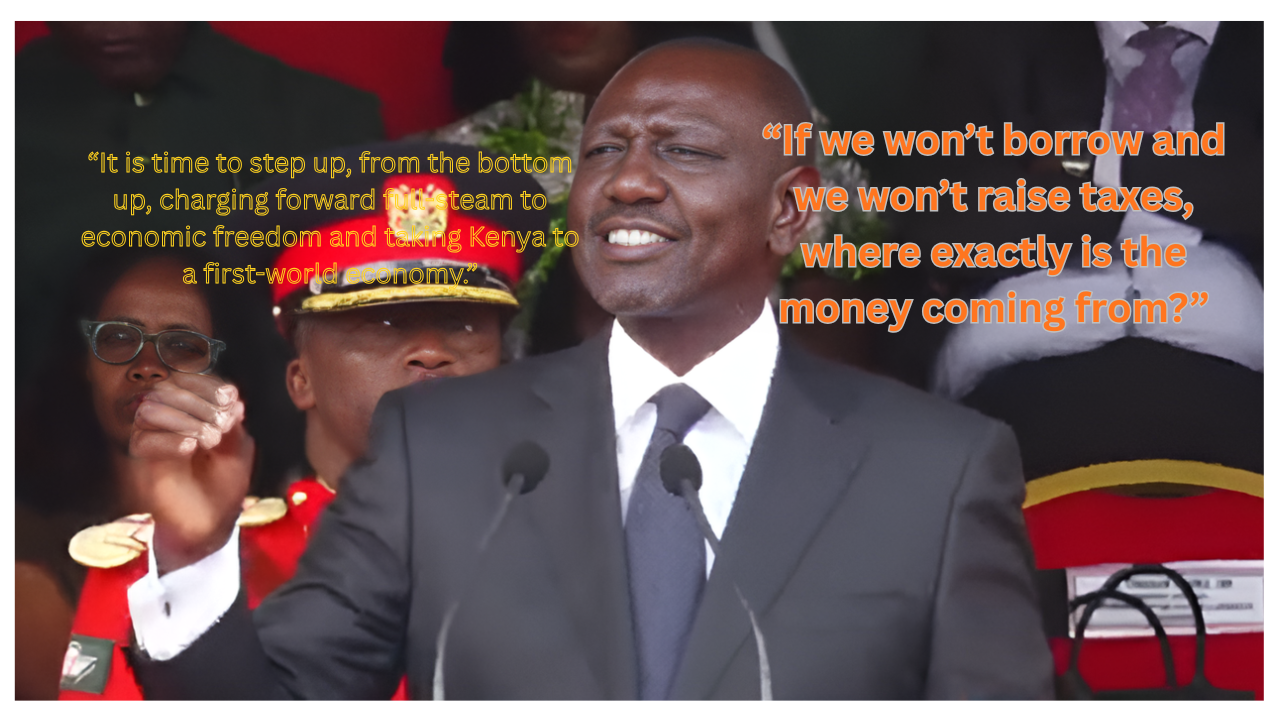
With the measures we have put in place to restore dignity, inclusion, and opportunity, we must now press on. It is time to step up, from the bottom up, charging forward full-steam to economic freedom and taking Kenya to a first-world economy.
Economic Stabilisation Achievements
Before accelerating this agenda, we stabilised the economy:
- Inflation fallen from 9.6% in 2022 to 4.5% last month.
- Shilling stabilised at about KSh 129 to the dollar for nearly two years.
- Foreign-exchange reserves exceed $12 billion — highest in independent Kenya.
- Economy now sixth-largest in Africa.
- Hustler Fund: over KSh 80 billion dispersed, 9 million repeat customers, over 7 million repaired credit histories.
These reforms have stabilised our economy, restored investor confidence, and enhanced Kenya’s creditworthiness.
Inspiration from Other Nations
As we set out on this path of economic independence, let us remember we are not the first to stand at such a crossroads. Nations like South Korea, Singapore, Hong Kong, and Malaysia once stood where we stand today — with limited resources but armed with immense courage, determination, and ambition. Prosperity was not handed to them. They reached out for it.
They rejected the ordinary. They believed in themselves and invested in their people. Today they stand as first-world economies not by accident, but by deliberate design, intentional choice, and purposeful conviction.
Kenya can, must, and will do the same — and more.
The KSh 5 Trillion Roadmap to Economic Freedom
Three weeks ago, during the State of the Nation Address, I laid before Kenyans this administration’s bold KSh 5 trillion roadmap to transform our nation into a first-world economy and secure our full economic freedom.
That roadmap is anchored on three unshakable national priorities:
- Modern transport and logistics infrastructure
- Shifting from a net importer to a net exporter of agricultural and manufactured goods through large-scale irrigation
- Scaling energy generation to at least 10,000 MW of new capacity in seven years
To finance this without overburdening Kenyans through debt or taxes, we are designing innovative mechanisms: the National Infrastructure Fund and the Sovereign Wealth Fund. Proceeds from privatisation will be ring-fenced for infrastructure that creates lasting value.
The Critical Enablers of Success
But fellow citizens, even the strongest financial systems, boldest infrastructure plans, and most ambitious economic strategies will fail if we do not secure the foundation of our national character.
The realisation of our economic freedom project will rest on three critical enablers:
- Strategic human capital development
- Robust peace, stability, and security
- Unwavering integrity and fidelity to the national interest
No nation can prosper in an atmosphere of disruption, violence, and criminality. Stability is not an option — it is the enabler of everything we seek to build.
Corruption is not merely the theft of money; it is the theft of hope, opportunity, and destiny. Our economic freedom project demands more than infrastructure and capital — it demands a renewal of our national conscience.
The Duty of This Generation
Fellow citizens, our founding fathers defeated colonial domination. The generation after broke the chains of dictatorship. The onus is on our generation — and particularly this administration — to achieve economic freedom: a freedom where:
- effort is rewarded,
- opportunity is shared,
- dignity is guaranteed,
- every citizen matters, and
- no Kenyan is left behind.
Let it be said of our generation that when Kenya stood at the edge of possibility, we chose:
- courage over comfort,
- action over excuse,
- unity over division, and
- excellence over mediocrity.
With resolute belief, today and every Jamhuri hereafter, may we be found the truest stewards of the freedom entrusted to us — that we shall honour our forefathers not only by remembering their sacrifice but by fulfilling the assignment of our generation: to secure for Kenya the full promise of economic freedom.
It is time to step up, from the bottom up, charging forward full-steam to economic freedom and taking Kenya to a first-world economy.
Thank you very much, and God bless Kenya.
More Posts
No more posts.