President Cyril Ramaphosa's Address to the Nation (South Africa) on November 30, 2025
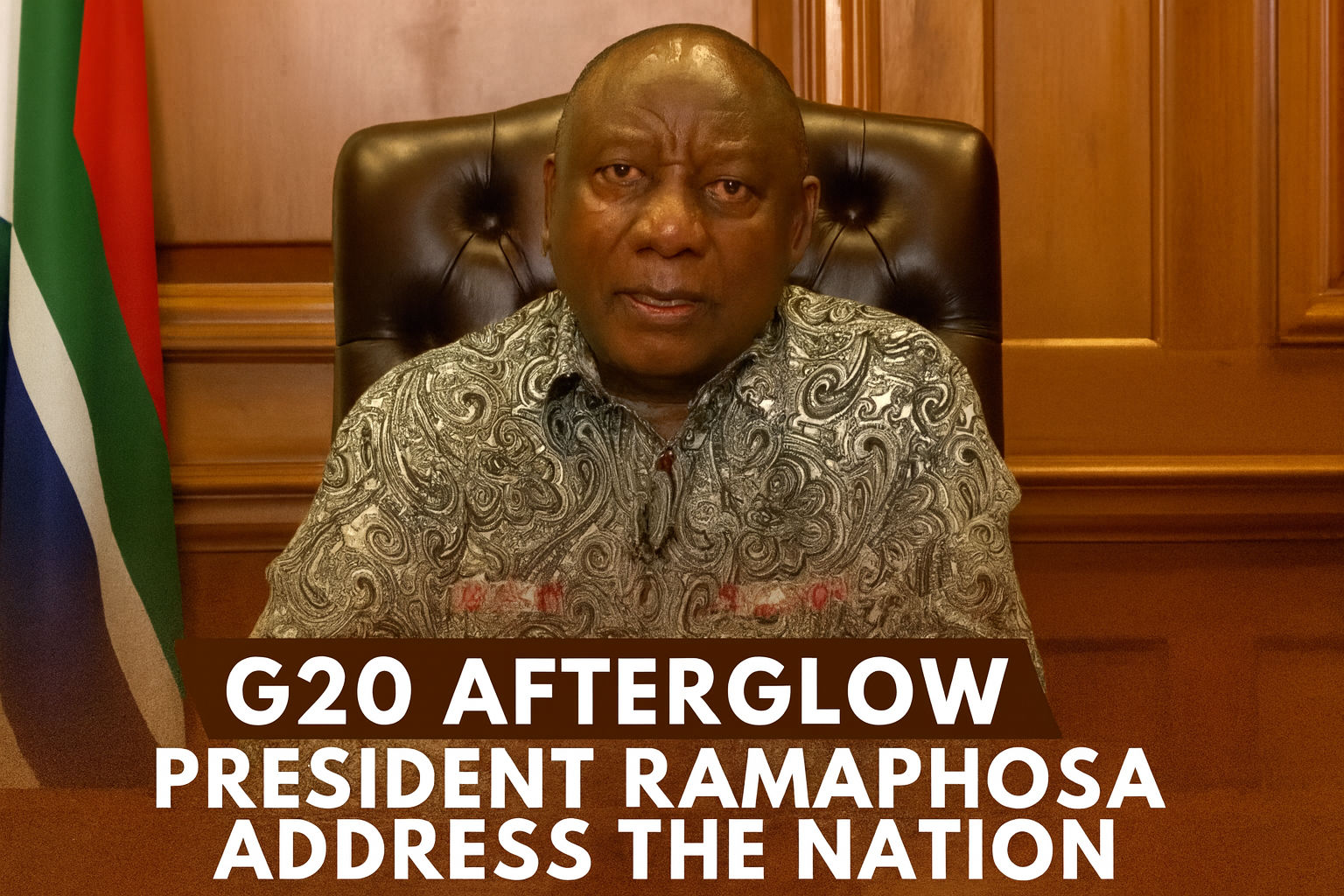
Allow me to express my profound gratitude to you all, my fellow compatriots, for ensuring and enabling our beloved country to host a series of successful G20 meetings throughout the year, ending with the G20 Leaders’ Summit.
When we launched the G20 presidency a year ago, I said that this must be the people’s G20.
- The people of South Africa must own and embrace this G20.
- It cannot belong just to the leaders but to the millions of people who have a stake in the discussions and the decisions that will be taken by the G20.
Delegates' Impressions of South African Hospitality
- A German delegate attending the summit is said to have commented: “I have attended summits on six continents. I’ve never experienced warmth like this.”
- A Japanese delegate had this to say: “Your security guards smile while being vigilant. Your drivers share stories while navigating. Everyone from the protocol officers to the coffee vendors treats us like welcomed family, not foreign dignitaries.”
- Commenting about our Ubuntu philosophy, one trade representative said: “In other countries, hospitality is a transaction. Here in South Africa, it feels like a tradition.”
- A French delegate shared something profound when they said: “We came to discuss economic frameworks, but what we’ll remember is how your people made us feel. That is not soft power. That is real power.”
- Another concluded by saying: “This weekend the world’s most powerful people aren’t talking about our GDP or our credit ratings. They are talking about our people — and that’s a currency no economy can print.”
Impressions Shared Online by World Leaders and Observers
- The Prime Minister of India, Narendra Modi, said: “Thanks to the wonderful people of South Africa and the government of South Africa for organising the summit.”
- The Managing Director of the International Monetary Fund, Kristalina Georgieva, praised South Africa’s incredible hospitality.
- Germany’s Chancellor Friedrich Merz posted: “In a difficult international environment, it is important to preserve the G20 as a forum for global coordination and to firmly integrate Africa. Thank you for your hospitality and ambitious presidency in these turbulent times.”
- The UN Development Programme’s South Africa representative wrote: “South Africa delivered a G20 that showed the world what African leadership looks like — dignified, strategic, and people-centred.”
- A young global leader from Kenya wrote: “No matter the language, Ubuntu is understood. South Africa brought that spirit to the G20 and the world felt it.”
This is what I’d like to thank the people of South Africa for:
- for showing up for your country,
- for standing by your country,
- for showing time and again that no matter what difficulties we face, when it comes down to it, we remain proudly South African.
And once again, as your President, I say thank you.
Scope of South Africa’s G20 Hosting
Over the past year, our country has hosted tens of thousands of delegates in more than 130 meetings in every part of our country — from Gqeberha to George, Cape Town to Hout Bay to Polokwane. We’ve also held meetings in other cities on the African continent and beyond our shores related to our G20 presidency.
Drawing from Brazil’s G20 presidency last year, we convened the G20 Social Summit to advance the voice of civil society and ordinary people. The Social Summit, attended by more than 5,000 people from around the world, was an exceptional celebration of the diversity and vibrancy of global civil society.
I know some of you might have been inconvenienced by the influx of visitors to our country. There were road closures and other disruptions to your daily lives.
- We thank you for being patient and understanding,
- and we apologise for any difficulties you might have experienced.
Thanks to All Who Made the G20 a Success
- We thank the many people from across the country who welcomed visitors to our cities and towns, through our airports, staying in our hotels, conference centres, restaurants and tourist sites.
- We thank our security services personnel who ensured that all G20 events took place without any incident.
- We thank all members of different social sectors who participated in the engagement groups and in other G20 activities throughout the year.
- We thank the business people who participated in the G20 business forums and the B20 for bringing together businesses from other countries to focus on and discuss our own economy.
- We thank the presiding officers and members of Parliament, members of the judiciary, academics and many others who organised their own sector G20 meetings.
- We also thank our media for keeping our people informed about the G20 processes unfolding all over the country.
- We thank our premiers for having been such welcoming hosts.
- We thank our mayors, councillors and municipal workers who worked so hard to prepare our host cities and towns for the arrival of our visitors — particularly Johannesburg, which hosted the Leaders’ Summit.
These cities and towns showed what can be done when a concerted and coordinated effort is made to fix potholes and street lights, to clean up our streets and maintain our infrastructure.
- This must continue past the G20 and must be expanded to areas of our towns and cities that have been neglected.
- This is the time to improve service delivery.
- We thank our Deputy President, our ministers and deputy ministers, our G20 sherpas and government officials who guided the deliberations with wisdom and purpose. They did considerable work to prepare the drafting of the declaration that was adopted.
Most importantly, I wish to thank each and every South African for contributing to this great success and for showing the world the strength of our values, the generosity of our people and the power of what we can achieve when we work together.
Broader Impact and Global Context
The impact of South Africa’s G20 extends beyond the warm welcome and the memorable experiences of our visitors. From the outset, we placed Africa’s growth and development at the heart of the G20’s agenda.
We undertook this responsibility at a time when the world is facing complex challenges — from wars and conflicts to rising inequality and the urgent threat of climate change. These challenges cause hardship and suffering across the world. They contribute to slower growth, weak investment and economic instability.
These challenges affect many countries, especially in the Global South. Here in South Africa, our people are confronted each day with poverty, unemployment and the high cost of living, which are made worse by poor service delivery in many areas of our country. It is therefore essential that we work together so that we can attract investment, promote inclusive growth and create jobs.
Through the work we are doing together, we are beginning to see the green shoots of an emerging economic recovery.
- Unemployment is falling and has been recorded as such in recent months.
- Our public finances are improving, allowing us to steadily reduce our national debt.
- We have recently seen a sovereign credit rating upgrade.
This progress was recognised in a recent speech by a prominent South African business leader who said that after a decade of decline, South Africa has turned the corner. He said our economic trajectory is positive and improving.
We are also working together to confront some of our greatest social challenges such as crime and the violence perpetrated by men against women. Just over a week ago, we classified gender-based violence and femicide as a national disaster. This classification should provide us with a broader range of measures to intensify our shared effort to end this scourge and pandemic.
While some sought to create division and polarisation between nations, we used our G20 presidency to reinforce our shared humanity.
- We fostered collaboration and goodwill.
- We affirmed that our shared goals outweigh our differences.
The Leaders’ Declaration adopted at the summit is a clear demonstration that the spirit of multilateral cooperation is alive and strong. The adopted declaration reinforces the importance of the G20 as the premier forum for international economic cooperation and its continued relevance in the face of a rapidly changing global environment.
This is particularly important as the G20 represents approximately 85% of the world’s GDP, more than 75% of world trade and around two-thirds of the world’s population.
We have ensured that this G20 is inclusive and reflects the strength in our diversity. Working with leaders of the G20 countries, we were able to find agreement on actions that will improve the lives of the people of South Africa, as they will improve the lives of people of Africa and the world at large.
Key Agreements Achieved
We found agreement on some of the issues that hold back the growth and development of our country and our continent:
- National Debt: Many countries, especially in Africa, spend more on debt repayments than they do on health, education or infrastructure. The G20 leaders agreed on further mechanisms to provide relief to countries with unsustainable debt levels, to reduce the cost of debt and to increase affordable financing, especially from international development banks.
- Climate Change: The G20 leaders recognised that climate change is having the greatest effect on those countries and communities that are most vulnerable. They agreed on increased funding and support for countries to prevent disasters and to rebuild in the wake of devastating climate disasters. There was agreement on increased funding for climate action — particularly important for countries like ours as we undertake a just energy transition to a low-carbon economy in a manner that protects workers, businesses and communities.
- Critical Minerals: The G20 leaders also agreed that the critical minerals the world needs should benefit those countries and communities where those minerals are found and extracted. There was agreement that countries like South Africa should be able to process and beneficiate the minerals they mine before selling them to other countries as finished products. This will create jobs for our people.
The agreements reflected in the G20 Leaders’ Declaration are just the beginning. We will continue to advocate for global progress on these and other priorities. Building on the foundation laid during our G20 presidency, we will work to advocate and fight for a more equal world.
- South Africa commissioned the work of the G20 extraordinary committee on global inequality, led by Professor Joseph Stiglitz, which produced the first G20 report on global inequality. The report sets out a clear set of recommendations to address this global challenge.
- We agreed that we will work with other willing countries to support the establishment of an international panel on inequality — similar to the Intergovernmental Panel on Climate Change — to provide authoritative assessments and recommendations.
- We will continue to call for more and better-quality financing for developing-economy countries to invest in their people and their futures.
- The G20 agreed that the great technological advances of our time in artificial intelligence and green energy should benefit all countries and not just a few.
Through these global agreements and actions, we will be better able to grow our economy and create jobs for our people.
G20 Membership and Participation
The G20 consists of 19 countries plus the European Union and now the African Union. As the G20 presidency, South Africa invited 16 guest countries to participate in the G20 discussions, including a number of African countries and Africa’s regional economic communities and financial institutions.
All G20 members attended all the G20-related meetings throughout the year except for one member country.
It is regrettable that the United States of America — a founding member of the G20 which takes over the presidency from South Africa in 2026 — chose not to participate in the G20 Leaders’ Summit and the final meetings leading up to that summit.
It is even more unfortunate that the reasons the United States gave for its non-participation were based on baseless and false allegations that South Africa is perpetrating genocide against Afrikaners and the confiscation of land from white people. This is blatant misinformation about our country.
We were most pleased that many organisations, businesses and individuals from the United States participated in large numbers in G20-related activities such as the Business-20 Summit and the G20 Social Summit. South Africa valued their constructive and enthusiastic participation.
Earlier this week, we formally handed over the G20 presidency for 2026 to the United States, observing the appropriate diplomatic protocols.
A few days ago, President Donald Trump made a statement to the effect that South Africa would not be invited to participate in the G20 in the United States. He repeated untrue statements about genocide against Afrikaners and the confiscation of land from white people in our country.
We must make it clear that South Africa is one of the founding members of the G20 and is therefore a member of the G20 in its own name and right. We will continue to participate as a full, active and constructive member of the G20 despite the challenges and misunderstandings that have arisen between South Africa and the United States.
South Africa’s Relationship with the United States
- South Africa remains a firm and unwavering friend of the American people.
- We recall the great solidarity movement in the United States that stood by our side in our struggle for democracy and freedom.
- We recall how the Bill of Rights in the United States Constitution inspired us as we wrote our own Constitution.
- We offer the people of the United States nothing but goodwill and friendship.
We affirm our commitment to continue to engage in dialogue with the United States government — and to do so with respect and with dignity as equal sovereign countries. We value the United States government and its people as a partner. We have common interests, common values, and a shared wish to advance the prosperity and well-being of the people of both of our countries.
As a country, we are aware that the stance taken by the United States administration has been influenced by a sustained campaign of disinformation by groups and individuals within our country, in the United States and elsewhere. These people who are spreading disinformation are endangering and undermining South Africa’s national interests, destroying South African jobs, and weakening our country’s relations with one of our most important partners.
We must remind these people that:
- South Africa is a constitutional democracy with a Bill of Rights that guarantees equality under the law.
- We have an independent judiciary able to uphold our Constitution and defend the rights of all South Africans.
- We are a country that has a tradition of dialogue, that has an enduring ability to come together to confront the challenges that we face.
- South African problems must be solved by South Africans themselves.
Call for National Dialogue
We have now embarked upon a national dialogue where all South Africans — from all walks of life, of all races and creeds — are invited to forge a new future for our country.
- In the tradition of Nelson Mandela and other great leaders that helped build our nation, we have determined that no one must be excluded.
- Every voice and every perspective must be heard.
And as we invite people to participate, we also invite those who are spreading misinformation about our country to bring their concerns and their solutions to the national dialogue.
We must never allow others to try to redefine our country, cause divisions amongst us or dictate who we are as a nation.
- We know who we are. We are South Africans.
- We are defined by our ability to work together and to find solutions to the problems that beset our country.
We live together, work together, learn together, laugh together, even play together. We also pray together — as we did today during the National Day of Prayer. We mourn together. We celebrate together and face our challenges together. In the best and worst of times, we have stood together.
We must work with greater focus and determination to address the many challenges our country is facing and make our South Africa a peaceful, prosperous and great nation.
And as our sports men and women have taught us, we are stronger together. Always.
Lastly, thank you once again for coming together as South Africans to host a very successful G20. You made us proud.
God bless South Africa.
I thank you.
More Posts
No more posts.